Presenting NPS data
What is Net Promoter Score (NPS)?
Net Promoter Score (NPS) is a measurement system that has been very successful as an overall satisfaction measure. It started as a customer loyalty metric but can be utilized to gauge learner satisfaction with training, as well. NPS can also be leveraged as an overall indication of perceived value.
NPS is always calculated on a 0-10 scale, using the questions:
- How likely are you to recommend this training to a friend or a colleague? (Post Event Surveys)
- How likely are you to recommend this learning experience? (Follow Up Surveys)
- How likely are you to recommend this learning experience? (Manager Surveys)
Respondents are grouped as follows:
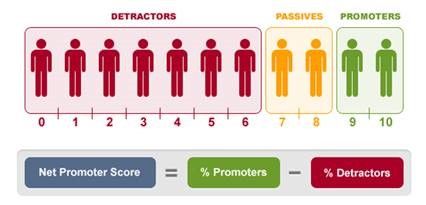
- Promoters (score 9-10) = loyal enthusiasts
- Passives (score 7-8) = satisfied, but unenthusiastic learners
- Detractors (score 0-6) = unhappy learners
Subtracting the percentage of Detractors from the percentage of Promoters yields the Net Promoter Score, which can range from a low of -100 (if every customer is a Detractor) to a high of 100 (if every customer is a Promoter). Net Promoter is sometimes expressed as a percentage and other times it appears as an integer. MTM uses a percentage format for displaying NPS scores.
How to present NPS data to stakeholders
- Provide an overview of the NPS metric (see information above) if you need to educate your stakeholders on what NPS is and why you’re using it on your learning surveys.
- Since NPS originated outside of Learning & Development and is a prevalent customer service key performance indicator, your stakeholders may already have familiarity with this metric. Therefore, you may elect to highlight this metric in your initial data analyses and stakeholder presentations until your audience becomes more acclimated with more advanced learning metrics such as Performance Improvement and ROI.
- Determine how you want to present NPS. Are you presenting it as a success (above benchmark or goal) or as an opportunity (below benchmark or goal)? Are you presenting an overall NPS for all your learning programs or just for certain courses or Portfolios? Consider referencing NPS by demographics if there are any interesting results to share by population. Consider comparing Post Event NPS vs. that reported on Follow-up evaluations.
- Provide your recommendations/action steps around either improvement or maintenance moving forward.
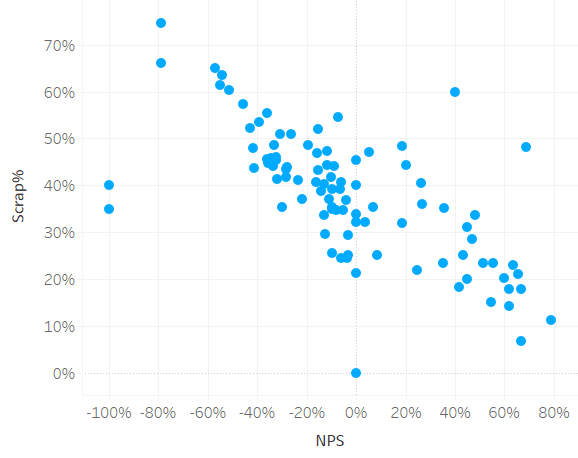
- Finally, you may choose to compare NPS and scrap learning on a scatter plot as shown below. Many organizations with whom we work are able to establish a correlation between the two – the higher the NPS the lower the scrap learning rate and vice versa.
Reports and tools that provide NPS data
- Key Metrics Report, run by Net Promoter Score
- Executive Summary Report, Key Metrics section
- Report Card Key Metrics Summary section
- Data Explorer > Metrics drop-down > NPS
- Quick Question Report
- Instructor Performance Summary
How to present Net Promoter data to stakeholders
Check out this 2:30 minute video to learn more.